Field Notes June 2026 · Paper published
Theoretical background for the book
Corporate Consilience: the systems-thinking foundations of the book, now published in the Journal of the International Society for the Systems Sciences.

Published paper · 2026
Corporate Consilience
Operationalizing Systems Thinking in Enterprise Transformations in the AI Era
- Author
- Kimmo Kontra
- Journal
- Journal of the International Society for the Systems Sciences, Vol. 70, No. 1 (2026)
- In
- Proceedings of the 70th Annual Meeting of the ISSS, Cyprus
- ISSN
- 1999-6918
12 pages · free PDF from journals.isss.org
How to cite
Kontra, K. (2026). Corporate Consilience: Operationalizing systems thinking in enterprise transformations in the AI era. Journal of the International Society for the Systems Sciences, 70(1). https://journals.isss.org/index.php/jisss/article/view/4638
The paper in brief
One number, four lenses, one answer
- The problem
- Enterprise transformations fail at a remarkably stable rate, and the failure is structural. Organizational knowledge is split into vertical silos (strategy, process, system, data) and horizontal governance domains (data, security, AI, compliance), so the organization cannot reliably query what it already knows.
- Why now
- AI agents need coherent, machine-readable context to act well. Bolted onto a fragmented organization, they inherit the fragmentation and multiply it. AI is the forcing function that finally makes systems thinking pay.
- The proposal
- The Spec-Driven Organization: a queryable World Model of the organization, held as a typed spec graph over a unified data substrate and governed by Orchestration Governance, Beer’s System 4–5 metasystem made explicit.
- The contribution
- Corporate Consilience, a mid-range design theory: why organizations fragment, how to re-couple representation and action, and a reflexive discipline, productive doublethink, that keeps it honest. Conceptual, grounded in transformation practice, with propositions others can test.
Four lenses that return the same answer
Cybernetic variety
Ashby · Beer · Meadows
Only variety can absorb variety; a viable organization needs an explicit metasystem.
Bounded and distributed cognition
Simon · Kahneman · Hutchins · Nonaka & Takeuchi
People satisfice; knowledge lives across people, tools and habits, not in one head.
Communication, knowledge and information
Conway · Shannon · Olesen-Bagneux
Systems copy communication structures; knowledge is a graph, not a pile of documents.
Complexity and antifragility
Snowden · Mintzberg · Taleb
Protect the complex from best practice; make change cheap enough to become optionality.
“Who in your organization will be the guardian of truth when the model speaks with perfect confidence?”
From the paper to the book
Where the theory lives in the book
The book speaks business language; the paper holds the scientific foundations. Here is where each idea of the paper turns up in the book.
The Iron Law: only 0.5% of large projects hit budget, schedule and benefits (§1)
1:200, Prelude and Chapter 1, The Hostage Situation
Knowledge fragmented on two axes: vertical silos and horizontal governance domains (§2)
Chapter 4, The Flood of Governances, and Chapter 6, Gonglomerate, Inc.Gonglomerate
A ceremonial output layer of decks and status packs that swallows the real work (§2)
Chapter 5, Slide Deck as the Executive Security Blanket
Conway’s law: organizations build systems that copy their communication structure (§5)
Chapter 3, The Fallacy of OneThe Fallacy of One
The World Model: the organization’s queryable self-description (§7.1)
Chapter 8, The Organizational Brain, and Appendix AThe Organizational Brain
Antifragility: cheap regeneration turns the cost of change into optionality (§6)
Chapter 9, The Infinite Optionality Engine, and Appendix BThe Infinite Optionality Engine
The archetypal synthetic company: model the essence, leave out the org chart, roles and IT systems (§7.5)
Chapter 10, Greenfield Thinking as Optionality SuperpowerGreenfield Thinking
The Orchestration Governance Center, a constitutional court for the seams between domains (§7.4)
Chapter 11, Orchestration GovernanceOrchestration Governance
Productive doublethink and the cognitive tax (§9)
Chapter 15, Don’t Resurrect the Syndrome
June 2026
The conference version
Before the conference: the June 2026 note
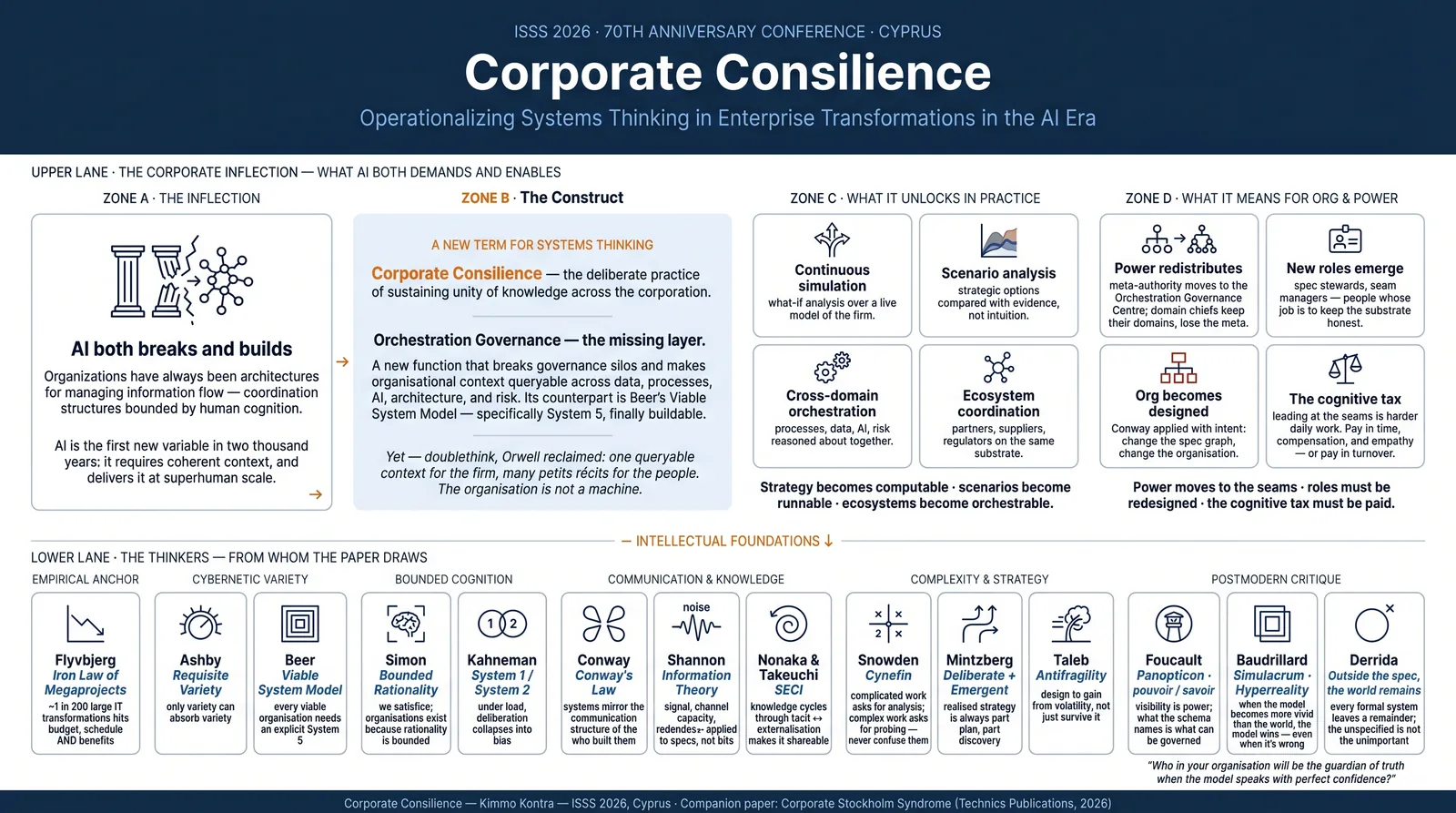
I’ve the pleasure to present at the International Society for the Systems Sciences (ISSS).
The paper is titled Corporate Consilience: Operationalizing Systems Thinking in Enterprise Transformations in the AI Era.
The not-so-household-word “Consilience” comes from a late-1990s book by the polymath Edward O. Wilson. He argued that the fragmentation of scientific knowledge is largely artificial — and that the next leaps come from consilience, the unity of knowledge.
What I now argue is that this applies also to businesses. I call it Corporate Consilience.
🧱 Background. Organizations have always been architectures for managing information flow. From Roman administration to the modern enterprise, they evolved as coordination structures bounded by human cognition. The silos we live with — HR, Finance, Operations, IT, Data, AI — emerged within those limits. They were rational. They are no longer sufficient.
🧠 AI both breaks and builds. It is the first technology that requires coherent organizational context to be useful, and the first that can deliver it at superhuman scale. That inflection is Corporate Consilience: the deliberate practice of sustaining unity of knowledge across the corporation.
🖥️ Technology alone won’t do it. The missing layer is Orchestration Governance — a new function that breaks governance silos and makes organizational context queryable across data, processes, AI, architecture, and risk.
🪴 Its counterpart is Stafford Beer’s Viable System Model — specifically System 5, the policy-and-identity layer. AI finally makes it buildable. With it, continuous simulation and scenario analysis move from boardroom intuition into operational practice.
♨️ And it will be uncomfortable. Radical organizational transparency disrupts power in ways the postmodernists — Foucault, Baudrillard, Derrida — wrote about for decades before anyone could build it. Orwell covers them, too: doublethink (aiming at a unified context BUT at the same time accepting that there in fact are many) is the daily discipline that keeps Consilience humane.
📖 On the bigger arc: this paper is the theoretical depth behind a practitioner-oriented book — Corporate Stockholm Syndrome, co-authored with Janne Vihervuori, out this autumn from Technics Publications.
Sincere thanks to those who shaped the argument. Professor Saku Mantere of McGill University offered kind guidance over pizza and beer — warning me off the trap of treating organizations as machines. (Heeded.) Dr. Ville Voipio and Dr. h.c. Risto Linturi brought sharp perspectives on the changing world. Dr. Ole Olesen-Bagneux’s emerging “metagrid” concept has shaped Corporate Consilience as a theory of convergence. And many others have helped structure the thinking.
ISSS was founded in the 1950s by Ludwig von Bertalanffy and his contemporaries. The 70th anniversary conference is held this June. To be among the speakers is, frankly, an immense honour.
Originally posted on LinkedIn — June 2026 · Kimmo Kontra
Since the conference
What the published paper sharpens
- System 4–5, not System 5 alone. Orchestration Governance is Beer’s metasystem read as the System 4–5 pair: the body that decides who the organization is must be the same one that reasons about the environment it faces.
- An operational form: the Spec-Driven Organization. Corporate Consilience gets a concrete shape: a queryable World Model, held as a typed spec graph of plain-text specifications.
- A holon, not a master schema. After Koestler, Checkland and Kurt Cagle’s holonic graph: where two parts of the organization disagree, the model records the disagreement with its provenance instead of merging it away.
- Productive doublethink. Orwell’s vice turned into its photographic negative: holding the one model and the many narratives at once, consciously and in the open.
- Four critical theorists, four disciplines. Lyotard joins Foucault, Baudrillard and Derrida. Each risk is paired with a design discipline: reciprocal transparency, reality grounding, schema humility and narrative pluralism.
- Testable, with stated limits. The paper says what it does not claim and ends with five design propositions for future research.
Related idea Orchestration Governance →