Corporate Stockholm Syndrome

Orchestrating a cure to release business-it-data hostages

Business, IT, and data rarely connect. Transformative projects keep failing — and people quietly live with it. Bolt-on AI only deepens the trap. This book is the cure: one shared, living model of the company, supported by a new way of governing and software — and an honest reckoning with what changes for everyone after the release.

We are writing this book in the open. Subscribe to follow the journey — early thinking, chapter previews, and behind-the-scenes reflections.

Kimmo Kontra
Janne Vihervuori
Curious? Scroll down.

The Arc

The book moves through three acts — the situation, the release, and what comes after.

1.

The Hostage Situation

Business, IT and data rarely connect. Transformative projects keep failing — and people quietly live with it. Bolt-on AI only deepens the trap.

2.

Releasing the Hostages

One shared, living model of the company — composable context, plain text in a vault — supported by a new way of governing and software. Agents read the model and act; documents become rendered views, not repositories.

3.

After the Release

Hard mental work for everyone. Power shifts as information stops hiding in silos. Roles change, the Roman-military hierarchy subsides, and the consulting-industrial complex will be shaken.

Underneath the arc: the model–execution gap disappears, data converges, real transparency to processes and data becomes possible, and organisations and roles change for good.

Field Notes

Field Notes

Short dispatches from the writing of the book — first posted to LinkedIn, collected here so they don’t scroll away. Newest at the top. Click a title to jump to the post; scroll on for the rest.

  1. JUN 2026 · Gonglomerate — where stagnation pays dividends
  2. JUN 2026 · Theoretical background for the book
Read the notes
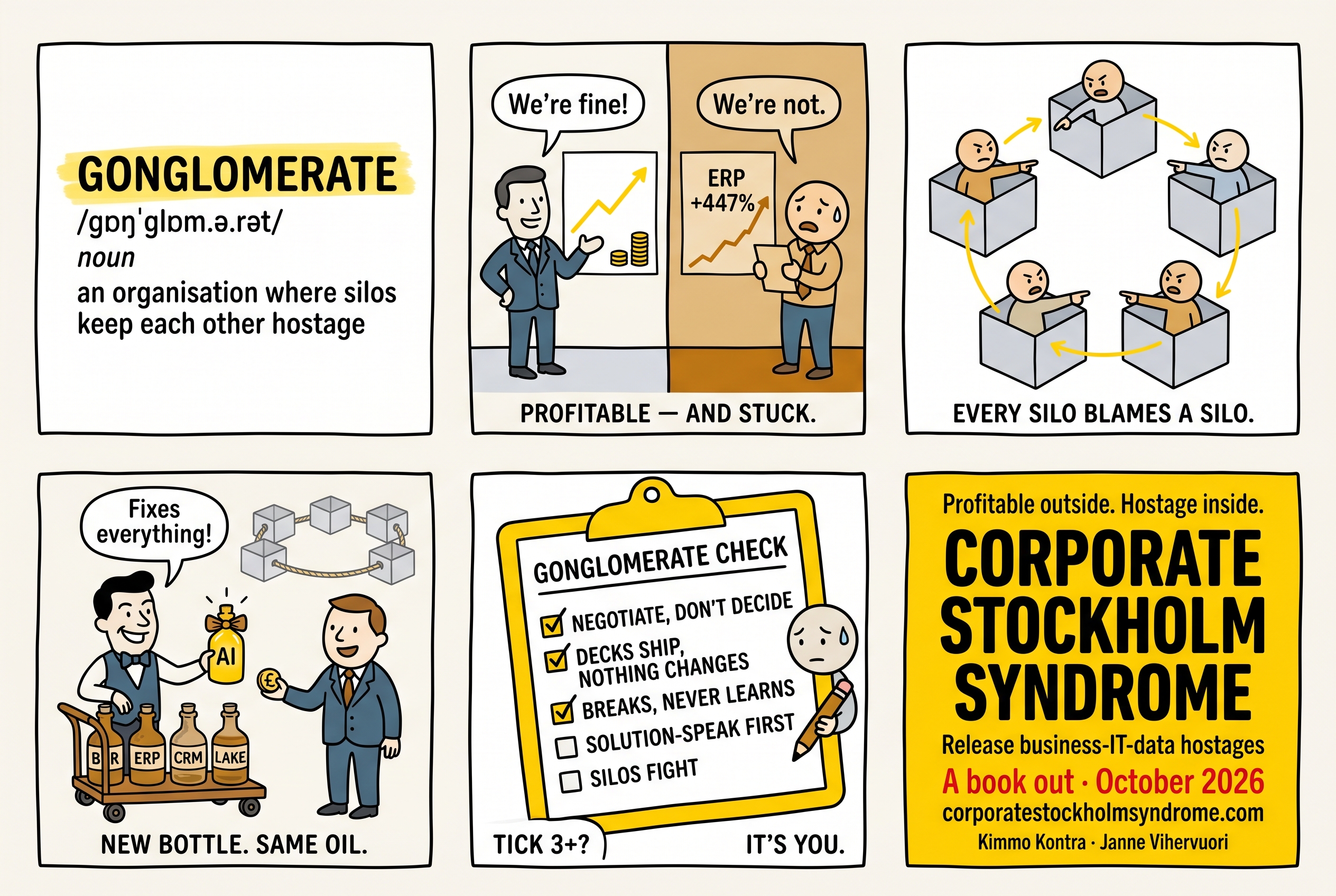
Gonglomerate cartoon — an organisation held hostage by its own silos

Gonglomerate — where stagnation pays dividends

Gonglomerate /ɡɒŋˈɡlɒm.ə.rət/ — where stagnation pays dividends.

Prof. Bent Flyvbjerg’s database of 16,000+ major projects says only ~8.5% hit cost and time. Hit cost, time and benefits? 0.5%. One in two hundred.

🖥️ IT-heavy transformations are among the worst — fat-tailed: the worst fifth of IT projects overruns by 447% on average.

🩺 A standard list of medicines exists among consultancies: emphasizing executive ownership, better PMO, more comms, better governance, better culture, focus on data, etc, etc.

🤯 What I find baffling is that everybody knows these standard meds, known for decades — although every evangelist offers them as fresh wisdom. But the numbers haven’t moved. Transformations keep screwing up; stats continue to be dismal.

🧠 …and now, more AI — surely that will help. Right?

😖 Wrong. The fundamental problem is that organizations are not working as systems but as collections of silos. Everything is built around them. That makes context management difficult or impossible — which is, correctly, said to be an impediment to AI, but the inability to get the context for the AI is caused by deeper structural issues.

In our upcoming book, Corporate Stockholm Syndrome, we gave this patient a name. We wanted a word for an organisation held hostage by itself — the silos, functions, process areas and professional disciplines all guarding each other, so that nothing can move. That’s a Gonglomerate.

The book gives the details, including a checklist for you to identify if you’re in a gonglomerate (“gonglo” among the friends 🙃).

To be clear: the coming book is NOT a cartoon. The strips are just the wave from across the room — behind them is practice-oriented, in-depth content on the diagnosis and the cure.

Stay tuned, follow me and my co-author Janne Vihervuori for more sneak previews in cartoon format! Publisher Steve Hoberman, DMC in Technics Publications.

(Our pledge: Gonglomerate / Gonglo is the only word in the book you can’t (yet 🙃) find in the Oxford Dictionary!)

The book is out in October 2026. 👇 Link to the book site www.corporatestockholmsyndrome.com.

Originally posted on LinkedIn — June 2026
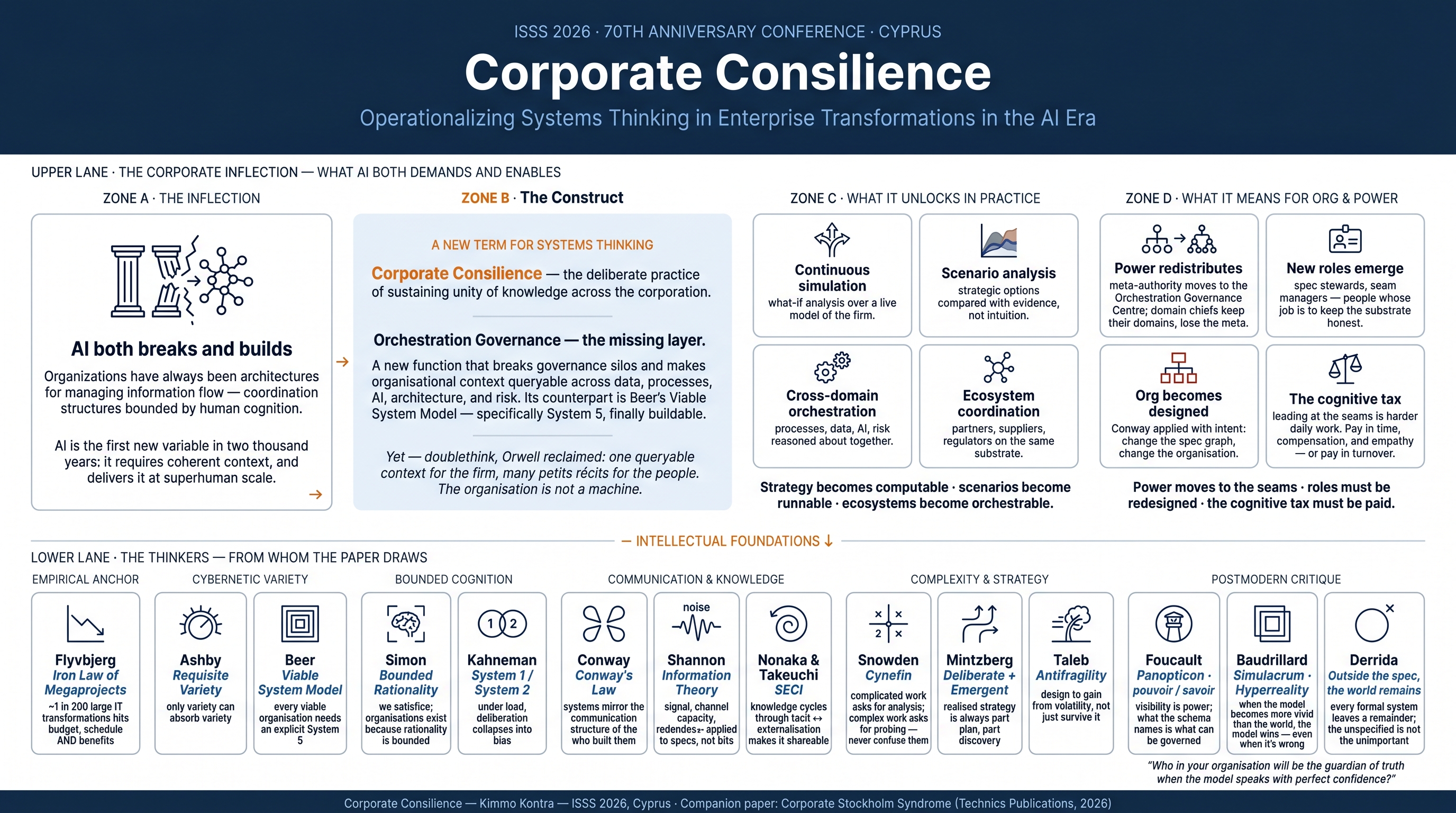
ISSS conference announcement — Kimmo Kontra presenting Corporate Consilience at the 70th anniversary of the International Society for the Systems Sciences

Theoretical background for the book

I’ve the pleasure to present at the International Society for the Systems Sciences (ISSS).

The paper is titled Corporate Consilience: Operationalizing Systems Thinking in Enterprise Transformations in the AI Era.

The not-so-household-word “Consilience” comes from a late-1990s book by the polymath Edward O. Wilson. He argued that the fragmentation of scientific knowledge is largely artificial — and that the next leaps come from consilience, the unity of knowledge.

What I now argue is that this applies also to businesses. I call it Corporate Consilience.

🧱 Background. Organizations have always been architectures for managing information flow. From Roman administration to the modern enterprise, they evolved as coordination structures bounded by human cognition. The silos we live with — HR, Finance, Operations, IT, Data, AI — emerged within those limits. They were rational. They are no longer sufficient.

🧠 AI both breaks and builds. It is the first technology that requires coherent organizational context to be useful, and the first that can deliver it at superhuman scale. That inflection is Corporate Consilience: the deliberate practice of sustaining unity of knowledge across the corporation.

🖥️ Technology alone won’t do it. The missing layer is Orchestration Governance — a new function that breaks governance silos and makes organizational context queryable across data, processes, AI, architecture, and risk.

🪴 Its counterpart is Stafford Beer’s Viable System Model — specifically System 5, the policy-and-identity layer. AI finally makes it buildable. With it, continuous simulation and scenario analysis move from boardroom intuition into operational practice.

♨️ And it will be uncomfortable. Radical organizational transparency disrupts power in ways the postmodernists — Foucault, Baudrillard, Derrida — wrote about for decades before anyone could build it. Orwell covers them, too: doublethink (aiming at a unified context BUT at the same time accepting that there in fact are many) is the daily discipline that keeps Consilience humane.

📖 On the bigger arc: this paper is the theoretical depth behind a practitioner-oriented book — Corporate Stockholm Syndrome, co-authored with Janne Vihervuori, out this autumn from Technics Publications.

Sincere thanks to those who shaped the argument. Professor Saku Mantere of McGill University offered kind guidance over pizza and beer — warning me off the trap of treating organizations as machines. (Heeded.) Dr. Ville Voipio and Dr. h.c. Risto Linturi brought sharp perspectives on the changing world. Dr. Ole Olesen-Bagneux’s emerging “metagrid” concept has shaped Corporate Consilience as a theory of convergence. And many others have helped structure the thinking.

ISSS was founded in the 1950s by Ludwig von Bertalanffy and his contemporaries. The 70th anniversary conference is held this June. To be among the speakers is, frankly, an immense honour.

Originally posted on LinkedIn — June 2026

Practical — Not Theoretical

This is not a theoretical exercise. It is not an IT book, not a data management handbook, and not a business strategy manifesto in isolation. It is about all three — written in pragmatic terms, with hands-on guidance for leaders who are done with frameworks that look beautiful on slides and fail in practice.

The book comes out in October 2026 from Technics Publishing, the publisher of the world-known Data Management Body of Knowledge and many thought-leadership books on data, AI, and technology.

Subscribe to follow the authors’ journey — early thinking, chapter previews, and honest reflections on what it takes to release the hostages.

Kimmo Kontra

Enterprise transformation advisor. Developer of the Orchestration Governance framework and the SDO concept. Decades across governance, data, IT strategy, and organizational design.

Janne Vihervuori

Co-developer of the SDO framework. Extensive experience in enterprise architecture and organizational transformation, in both leading consulting and global line management roles.

Contact: Kimmo.Kontra@definio.com