In 30 seconds
- Strategy lives in slides, real work survives in shadow spreadsheets, and ten committees govern the silos while nobody governs the seams.
- The captor is not a person. It is the fragmented way the organization knows itself.
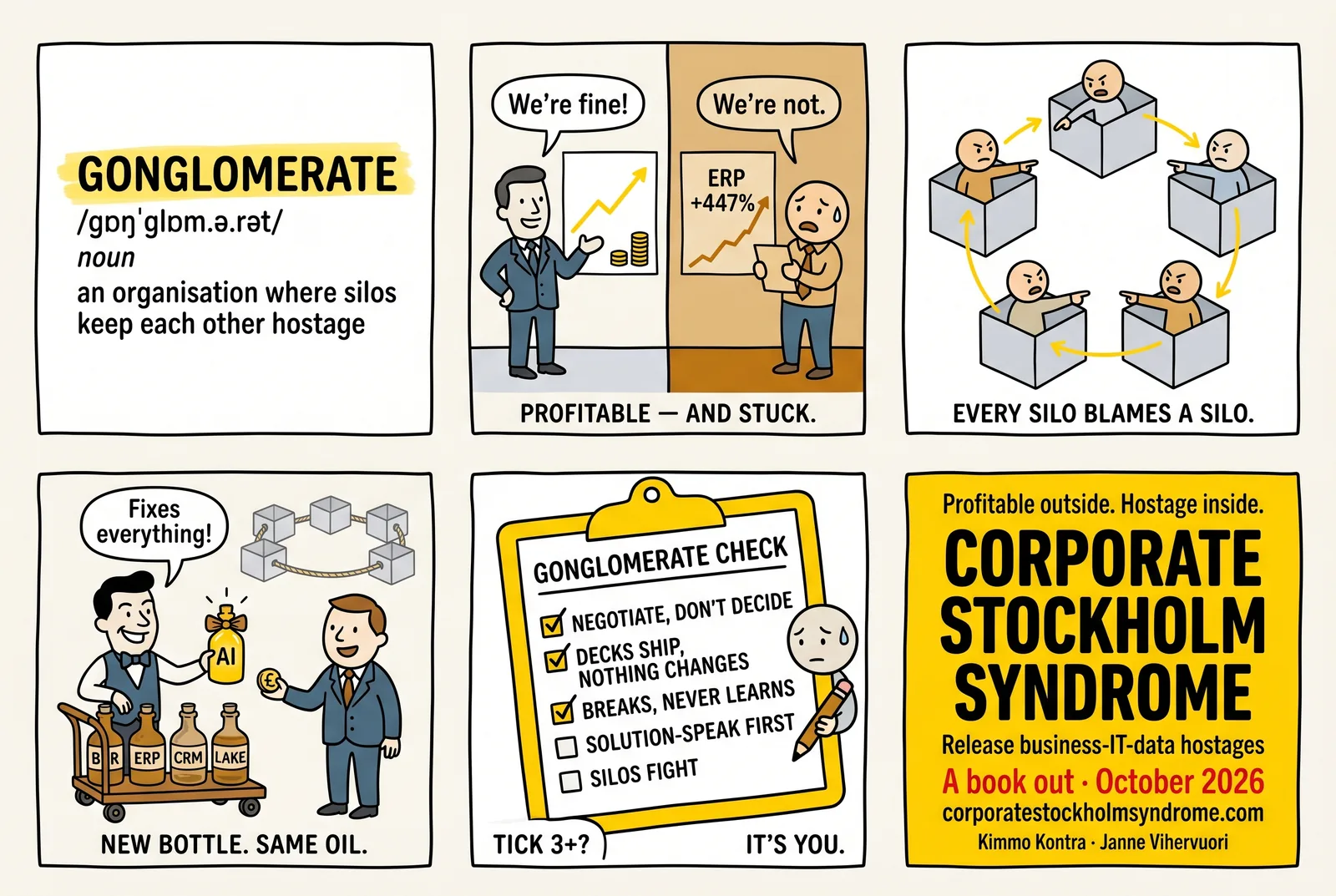
- Five symptoms give it away. Tick three or more, and you are living inside one.
Nobody is holding the gun
In August 1973, four bank employees were held hostage in a Stockholm vault for six days — and came out defending their captors. A criminologist gave the paradox a name: Stockholm Syndrome.
Walk into any large enterprise and you will find the same arithmetic running in better lighting. The condition — budget-busting, mind-numbing development projects — is expensive, but the expense is familiar: priced into budgets and absorbed into careers. The cure is disruption: unfamiliar, violent to the org chart, and arriving on someone else’s schedule. So the organization fears the cure more than the condition.
The cast
- The hostages are your people: bright, well-meaning, highly trained.
- The captor is not the CIO, the vendors, middle management or “the culture”. It is the fragmented way the organization knows itself — what it wants, how it runs, what it has decided — scattered across decks, process maps, system configurations, spreadsheets and the memories of a few senior people.
- Stockholm behavior is what captivity does to good people: defending the multi-million delay, explaining failures away, closing ranks the moment an outsider questions the arrangement.
The roles refuse to stay put. You can be a hostage at nine, a captor by eleven, and back in the vault by lunch.
Gonglomerate Inc.
We call the organization where the syndrome has fully matured Gonglomerate Inc. The word is deliberately ugly. It is not one company but a pattern that recurs across most large organizations most of the time:
- Large enough to fragment — hundreds of processes, dozens of systems, thirty-plus committees, five professional vocabularies.
- Successful enough to be tired — often profitable, dividend-paying, and drowning in legacy debt.
- Comfortable enough to stop fighting — the failure rate is no longer a crisis but a line in the budget.
The way out starts inside
You cannot cure a Gonglomerate by redecorating the vault, buying another “one”, or redrawing process swim lanes. Every symptom traces back to one thing: how the enterprise knows itself.
The vault door was never locked from the outside.
“They have normalized the abnormal so thoroughly that the abnormal has a steering committee.”
Cartoons
June 2026
Gonglomerate
An organization where silos keep each other hostage, in six panels: the definition, the profitable-but-stuck company, every silo blaming a silo, AI sold as a fix-everything bottle, the Gonglomerate Check, and the book.
Field Notes