In 30 seconds
- Every governance committee exists for a good reason. Together they are mathematically unsustainable.
- The pain lives in the borderlands, where no committee has jurisdiction.
- AI may perform analysis; only governance can authorize commitment.
The Thursday morning ritual
Every Thursday, Gonglomerate Inc. runs a quiet, expensive ritual. Enterprise Architecture meets in one room, Information Security down the hall, Privacy, Risk, Compliance and Legal across the corridor — and this year’s newest arrival, AI Governance, unpacks its shiny framework in the corner office.
Each committee was formed for a good reason. Together they are impossible: no executive team can genuinely own ten of them, and no program can navigate ten frameworks. Governance becomes a tax — or it is quietly ignored so that real work can happen.
“We need AI governance!”
Understandable. As an organizing answer, wrong. Much of the new work belongs inside disciplines that already exist; an umbrella over the umbrellas just gives you an eleventh committee — the Fallacy of One in governance form. Meanwhile AI turns the flood into a flash flood: an agent can create hundreds of artifacts before the first review.
The pain lives in the borderlands
Inside their own rooms, functional governance mostly works. The pain lives between the rooms. AI wants more data while privacy wants less. Security collides with usability. Consistency competes with speed. Nobody referees.
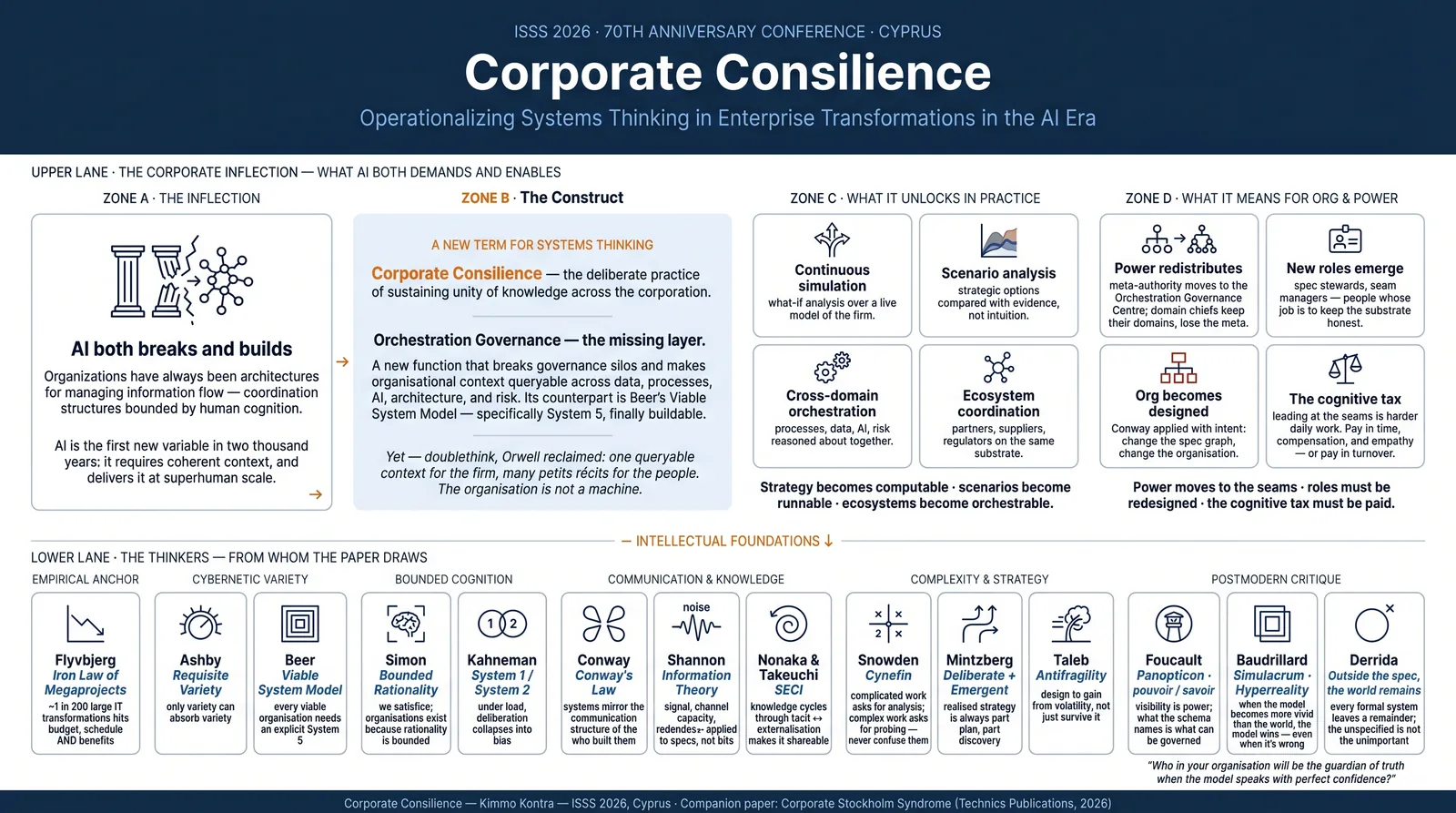
Orchestration, not another committee
Orchestration Governance keeps the domain experts and adds the missing complement. It makes cross-enterprise dependencies visible, prices the costs and gains that vanish inside specialist views, and gives the right decision-maker one structured view when legitimate goals collide.
At its heart sits a small Orchestration Governance Center — something like a constitutional court. The board and CEO write the constitution; the center interprets the shared formats and guardrails, rules on cross-domain conflicts, and records each ruling with its evidence, reasoning and conditions for reopening. It must stay small, report to the top, and never become a delivery empire.
What discipline buys
The hostage company debates the same question for years, because nobody can enforce the earlier answer. The released company stays decided until reality — not politics — reopens it.
“Orchestration Governance optimizes the system, not its parts.”
Field Notes